
Ready to learn how to start day trading futures with just $1,000? It’s more achievable than most beginners think — especially with today’s micro futures contracts that let you trade the S&P 500, NASDAQ, and crude oil with as little as $50 in intraday margin. But make no mistake: futures trading is a skill that takes months to develop, and most beginners who jump in without a plan lose capital fast. This step-by-step guide covers exactly how to start day trading futures with $1,000 — the right platforms, the right contracts, the right risk rules, and the gear that gives you an edge.
How to Start Day Trading Futures – What You Need Before You Begin
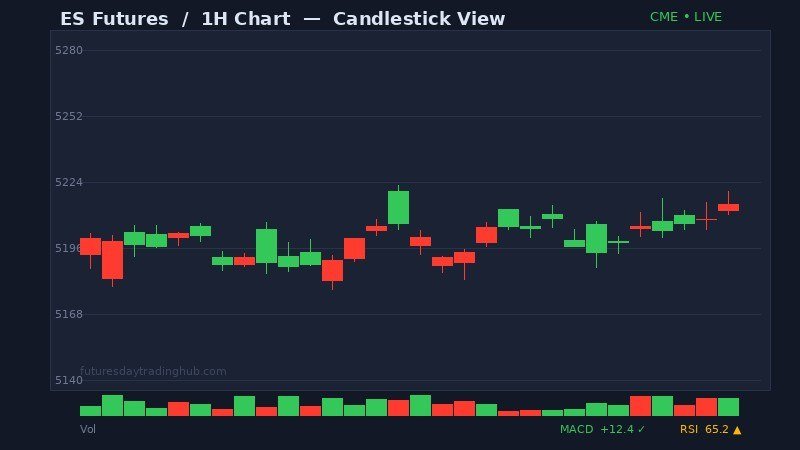
Before placing a single live trade, get these fundamentals in place:
- Education first: Spend 30–60 days in simulation. No exceptions.
- Choose the right contracts: Micro futures (MES, MNQ) only until consistently profitable.
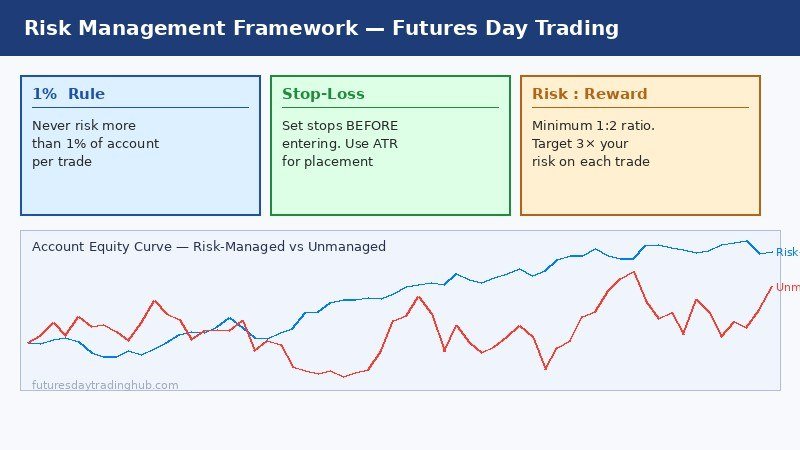
- Define your risk per trade: Never risk more than 1–2% of your account per trade ($10–$20 on a $1,000 account).
- Pick one setup: Master one trading pattern before learning others.
- Track every trade: A trading journal separates professionals from gamblers.
How to Start Day Trading Futures with $1,000 – Step-by-Step
Step 1: Open a Futures Trading Account
The best platforms for beginners with $1,000 accounts are NinjaTrader (lowest commissions at $0.09/side with their brokerage) and Tradovate (clean interface, flat-rate pricing). Both offer free simulation modes — use them for at least 30 days before going live. Visit our platform comparison guide for a full breakdown.
Step 2: Start with Micro Futures Only
With $1,000, trade MES (Micro E-mini S&P 500) or MNQ (Micro NASDAQ-100) exclusively. Each MES tick = $1.25; each MNQ tick = $0.50. This means you can participate in full index moves with manageable risk. Standard ES/NQ contracts have 10x the tick value — one bad trade on a standard contract can wipe a $1,000 account.
Step 3: Learn One Strategy and Master It
The most beginner-friendly futures strategies are:
- Opening Range Breakout (ORB): Mark the high/low of the first 15–30 minutes. Trade breakouts above/below that range in the direction of the trend.
- VWAP Reversion: Buy when price pulls back to VWAP in an uptrend; sell when it pushes to VWAP in a downtrend. High-probability mean-reversion trades.
- Support/Resistance Bounces: Identify key daily/weekly S/R levels. Trade bounces with clear invalidation points for stop placement.
Pick one. Trade it in simulation for 60+ trades before going live. Track every trade meticulously.
Step 4: Apply Strict Risk Management
This is where most beginners fail. Your rules:
- Maximum risk per trade: $10–$20 (1–2% of $1,000 account)
- Daily loss limit: $30–$50 (3–5%). If you hit it, stop trading for the day.
- Always use stop-loss orders — never trade without a defined exit
- Minimum 1:2 risk-reward ratio (risk $10 to make $20 minimum)
Step 5: Track Everything in a Trading Journal
Record every trade: entry price, exit price, setup name, emotional state, result. After 50–100 trades, patterns emerge — your best setups, your worst times of day, your emotional triggers. Without data, you’re flying blind.
Best Books for Learning Futures Day Trading
A Complete Guide to the Futures Market – Jack Schwager — The definitive textbook. Technical analysis, fundamental analysis, trading systems, and risk management all in one comprehensive volume.
Trading in the Zone – Mark Douglas — The most important trading psychology book ever written. Read this before trading a single live dollar.
UPLIFT V2 Standing Desk — Serious day traders need a proper ergonomic setup. The UPLIFT V2 handles triple monitor setups with ease and keeps you comfortable through long trading sessions. 15-year warranty.
Dell UltraSharp U2723QE 27″ 4K Monitor — Read charts at 4K resolution. The pixel density makes candlestick patterns and order flow significantly easier to read. USB-C connectivity simplifies your desk cable management.
How to Start Day Trading Futures – FAQ
How much money do I need to start day trading futures?
With micro futures, you can technically start with $500–$1,000. However, $2,500–$5,000 gives you proper risk management room. At $1,000, keep position size to 1 MES/MNQ contract maximum and risk $10–$20 per trade. Never over-leverage a small account — it’s the fastest way to blow up.
Is day trading futures profitable for beginners?
Most beginners lose money initially — studies suggest 70–80% of retail futures traders are unprofitable in their first year. However, traders who spend significant time in simulation, master one strategy, and apply strict risk management can become consistently profitable. It’s a skill like any other — it takes 6–18 months of serious practice to develop.
What are the best futures contracts for beginners with $1,000?
MES (Micro E-mini S&P 500) is the best starting contract for most beginners. It’s the most liquid micro contract, tracks the US stock market intuitively, and has low intraday margin (~$40–$100 depending on your broker). MNQ (Micro NASDAQ) is also excellent for tech-sector traders.
How many hours a day do futures day traders work?
Most successful day traders focus on the first 2 hours (9:30–11:30 AM ET) and sometimes the last hour (3:00–4:00 PM ET) of the regular session. Futures trade nearly 24 hours, but the highest volume and best setups occur during US market hours. Quality over quantity — 2 good trades a day beats 10 mediocre ones.
Final Thoughts – Starting Your Futures Journey with $1,000
Learning how to start day trading futures with $1,000 is entirely achievable — but it requires discipline, patience, and a willingness to treat it as a professional skill development process. Spend 60+ days in simulation, master one strategy, apply strict risk rules, and journal everything. For more futures trading strategies, platform reviews, and trading desk setup guides, explore FuturesDayTradingHub.com.
Comments
3 responses to “How to Start Day Trading Futures with $1,000 – Step-by-Step Guide”
[…] platform. Check our best futures trading platforms guide to set up your trading workspace, or read how to start day trading futures if you’re starting from […]
[…] you’re completely new to futures trading, start with our step-by-step guide to day trading futures before diving into this comparison. Already know the basics? Let’s compare these two giants […]
[…] gains, then ordinary income (up to $3,000/year). Excess losses carry forward to future years. Read our futures guide for strategy […]